
Garage Door Repair: Repair or Replace? How Davie Homeowners Decide
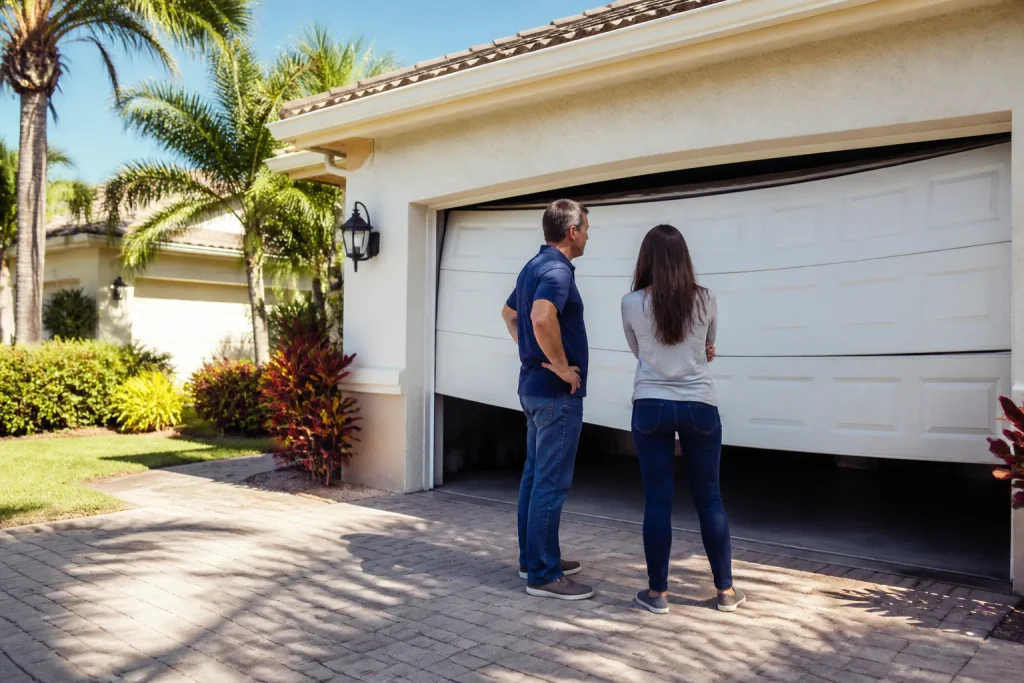
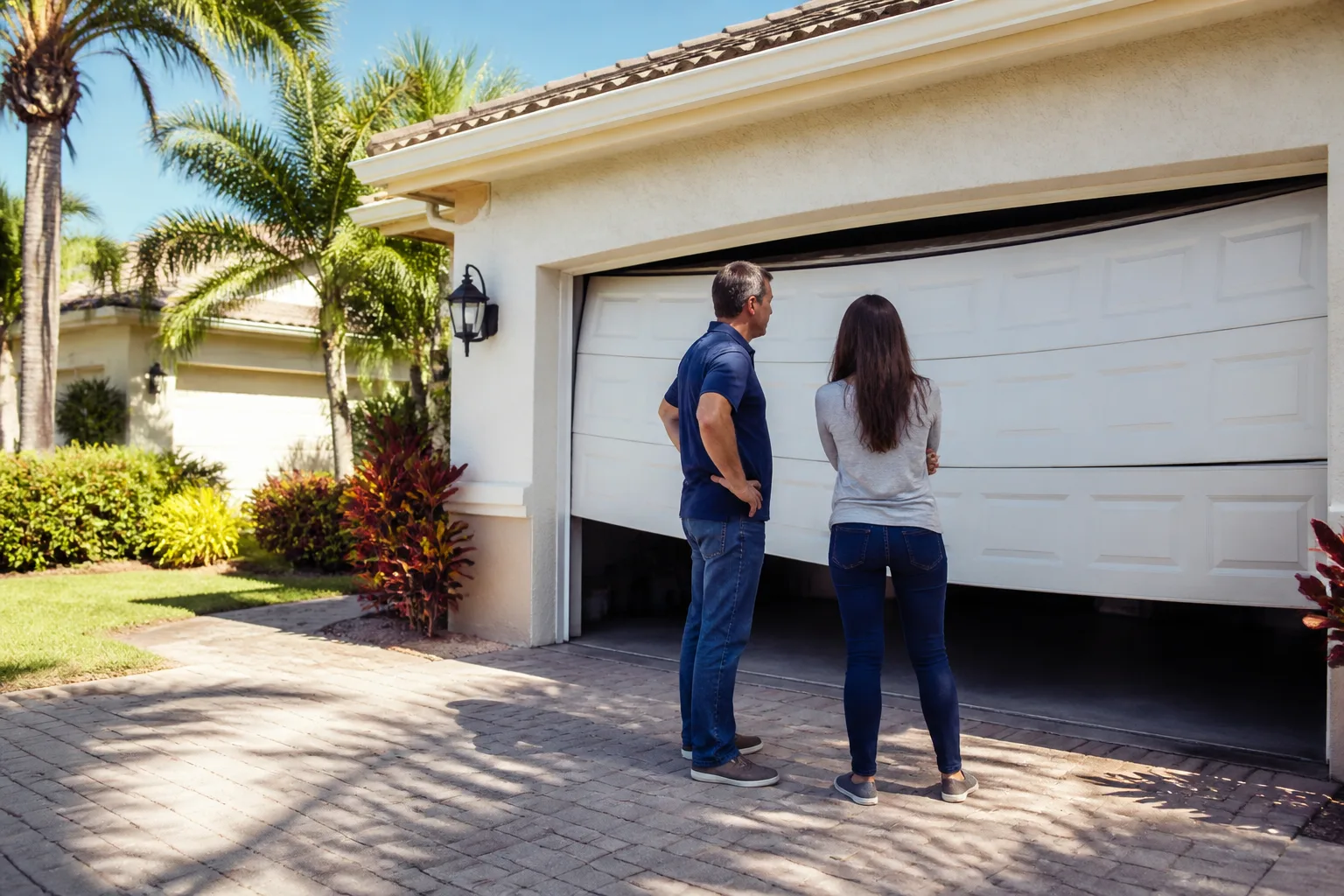
Most homeowners ask the wrong question first. They look at a door that’s fifteen years old, hear a loud bang from the garage, and assume the door itself has reached the end of its life. But a fifteen-year-old door with a broken spring usually makes clear financial sense to repair – the spring failed on schedule, not the door. That same door with two warped panels and worn rollers is a completely different calculation. Conflating those two scenarios is how people end up replacing a perfectly sound door, or patching one that’s already failing. If you’d rather not sort through it alone, call (855) 658-4182 and we’ll walk through it with you.
What’s the direct answer on repair versus replace?
Repair is almost always the right call when the failure is mechanical: a snapped spring, a dead opener, worn rollers, a bent track, or a cable that’s come off. Replace becomes the better call when the failure is structural – dented or rusted-through panels, a sagging section, a door that no longer seals, or a frame that’s pulling away from the opening. Age on its own tells you almost nothing.
In our experience across Davie Garage Door Repair Pros, the honest test comes down to three things: what the repair costs, whether the door’s mechanical integrity will hold up after the fix, and what a replacement would actually cost installed in the current Davie market. Most homeowners skip the third part because they assume replacement is unaffordable. Getting a real installed number first makes the repair decision far clearer.
A simple way to frame it:
- Single repair under 30% of replacement cost: repair, unless the door has structural damage.
- Single repair between 30% and 50% of replacement cost: repair if the door is structurally sound and the opener is still healthy; replace if either is questionable.
- Single repair over 50% of replacement cost: replacement usually wins, especially if the repair is one of several on the horizon.
- Any structural damage affecting the seal or operation: replacement, regardless of repair cost.
That last point catches people. A door can run smoothly and still be failing structurally at the bottom seal, which lets rain blow in and rots the frame over time.
How do you tell structural damage from a mechanical failure?
Separate the two ideas before you talk to anyone. Mechanical parts are designed to wear out: springs, rollers, cables, and openers are consumables. Structural parts are supposed to hold their shape for the life of the door: the panels, stiles, bottom section, and the frame around the opening. A door with sound structure but a snapped spring is a repair candidate every time. A door with cracked panels and a failing bottom seal is not, even if the springs are fine.
Davie’s summer humidity is hard on wood-composite and steel doors. We see more bottom-section rot and rust along the bottom edge here than in drier climates. That’s a structural problem, not a mechanical one, and it changes the math. A door whose bottom panel has rotted through will keep shedding parts from the frame up, no matter how many springs you replace.
Weather-seal failure is the sneaky one. When the rubber gasket under the door flattens or tears, the door stops sealing against the floor and the frame. Water gets behind the door, the frame stays wet, and eventually it swells. Homeowners usually notice the draft before they notice the damage underneath.
Does wind-load compliance change the decision in Davie?
Yes, and this is the part most homeowners don’t hear until they’re already replacing. Broward County and Miami-Dade enforce wind-load requirements on garage doors, and those requirements change how an older door is treated by insurers and inspectors. An older door that meets today’s standards can be repaired without issue. An older door that doesn’t may be a replacement decision regardless of how well it runs – not because the door is broken, but because you can’t get coverage you’re comfortable with.
Check your homeowner’s policy and your door’s labeling before you commit to repair. If your door’s rating doesn’t meet current requirements, or there’s no label at all, ask your insurer what they require in writing. That documentation often decides the repair-or-replace question faster than any cost calculation.
The good news is that most older doors in Davie can still be repaired. The bad news is that a repair only helps if the door underneath it is compliant. We’ll tell you straight if that’s the case – we won’t push a replacement you don’t need.
What’s the repair cost threshold for a Davie door?
There’s no universal dollar figure, but the formula is reliable. Get a written replacement quote from a licensed installer, then compare your single biggest repair against it. If the repair exceeds roughly a third of replacement cost, and the door is showing other wear, replacement is usually the better use of the money. If it’s under a fifth, repair it and move on.
Typical repair cost ranges most Davie homeowners see:
| Repair | Typical cost (each) |
|---|---|
| Single torsion spring | Lower hundreds |
| Matched spring pair | Roughly double a single spring |
| Broken cable (per side) | Lower hundreds |
| Roller set replacement | Low to mid hundreds |
| Panel replacement (single) | Mid hundreds, depending on panel and finish |
| Opener replacement (unit + install) | Mid to upper hundreds |
Installation cost for a full replacement varies widely by door material, insulation, and window options, which is why the replacement benchmark matters. A written quote is the number you’re comparing against – estimates over the phone only give you a rough feel. Call (855) 658-4182 for a free estimate – we’ll give you the number in writing so you can run the math yourself.
One note on springs: a spring repair is priced per spring. If both springs have equal wear, we’ll usually recommend replacing both, since a matched pair is a safer and cheaper long-term move than replacing one at a time.
When should replacing the door also mean replacing the opener?
Any time the new door is heavier than the old one, the opener must be replaced or upgraded. Insulated doors, doors with windows, and doors with a different material generally weigh more, and an older opener sized for a lighter door will burn out trying to lift the new one.
If a new door is heavier, an opener repair will not solve the problem, and old openers will fail within months. If the new door is roughly the same weight, the current opener can often be kept if it’s still meeting safety requirements: the auto-reverse test passes, the safety sensors work, and its manufacturer’s wireless standard is current. We work on LiftMaster and Chamberlain systems specifically, so if yours is one of those, we can tell you quickly whether it’s worth keeping.
If you’re replacing the door and you have an older Craftsman or Raynor opener, it’s worth revisiting the opener at the same time. The savings in one stop usually outweigh the risk of a failed opener a year down the road.
What five things should you check before calling us?
Run this checklist yourself before the technician arrives. It takes about ten minutes and lets you grade your door’s condition honestly, so you enter the conversation informed instead of guessing.
- The panel test. Run your hand along each section. Any soft spot, rust-through, or flex under pressure means the panel is failing and the door is a replacement candidate.
- The seal test. Close the door and look for daylight along the bottom seal. Any gap wider than a finger means the seal is toast and the door is not sealing.
- The balance test. Disconnect the opener (pull the release cord), then lift the door by hand to about waist height. It should hold. If it falls or needs real effort, the springs or cables are out of balance.
- The roller check. Look at the rollers on the sides. Flat-spotted, chipped, or gritty rollers are cheap to replace and a clear signal the door is on a maintenance curve.
- The frame test. Look at the wood around the opening where the door meets the wall. Any rot, swelling, or soft spots means the door is no longer structurally supported properly.
If all five pass, repair is usually the right answer, no matter how the door looks. If two or more fail, replacement usually wins. Springs and cables are dangerous, and we don’t recommend testing them by hand beyond noting whether the door holds its position. If anything feels off, stop and call us.
When to call a pro
If the door won’t lift, won’t close, or has snapped a spring or cable, stop using it. A damaged spring can injure someone badly, and a cable under load can whip. Move the vehicles out of the garage, keep the door still, and call us. That’s what our spring repair and garage door repair service is for. If you’re already leaning toward replacement, our garage door installation team can measure and quote the replacement before you commit – no pressure, no upselling.
Related services in Davie: spring repair, opener repair, panel replacement, and full new-door installation. One call covers it.
The Bottom Line
Age alone isn’t a reason to replace a garage door. Mechanical wear isn’t either. What matters is whether the door’s structure is still sound, whether the repair cost is a sensible fraction of a real installed replacement number, and whether the door meets current wind-load requirements for insurance. Run the five-point check, get a written replacement quote, and the decision usually makes itself. If you’re in Davie and need help, Davie Garage Door Repair Pros offers free estimates – call (855) 658-4182. We answer 24/7. Fast dispatch from 7am to 7pm, Sunday through Friday.
Frequently Asked Questions
Usually, yes – if the door is structurally sound. A fifteen-year-old door with a snapped spring or worn rollers is a repair candidate, because the spring and rollers were designed to wear out. The door itself is still good. If the same door has wavy panels, bottom rot, or a failing seal, those are structural problems and replacement is the better answer. Call (855) 658-4182 for a free estimate – estimates are free.
Most repairs fall in the low hundreds, though it depends on what’s failed. A single spring, a per-side cable, or a roller set is on the lower end. A panel replacement or opener replacement runs higher. A matched spring pair is priced roughly double a single spring because the pair should usually be replaced together. Written estimates are free – call (855) 658-4182 and we’ll give you the number in writing before we touch anything.
No. The written estimate is the price. We quote and agree before any work starts, and if we find something the estimate didn’t cover, we stop and re-quote with you before touching it. You won’t get a surprise invoice at the end. Call (855) 658-4182 to schedule an estimate.
Not automatically. It depends on whether your door can be brought up to compliance with the door you have. Check your homeowner’s policy and your door’s labeling first, and ask your insurer in writing what they require. If the current door can meet the requirement, repair usually works. If it can’t be brought into compliance, replacement may be necessary for coverage. We’ll tell you straight which side you’re on. Call (855) 658-4182 for a free estimate.
Written by the team at Davie Garage Door Repair Pros.
Need Garage Door Help?
Call Davie Garage Door Repair Pros - the local pro we connect you with is licensed and insured, here with fast help in Davie.
(855) 658-4182