
Top Signs You Need Garage Door Service – Don’t Ignore These
A garage door that takes two seconds longer to close than it did six months ago isn’t slowing down randomly. It’s a torsion spring losing cycle life, and that spring has a predictable failure point most homeowners reach without ever knowing the countdown started. The warning window usually runs 30 to 90 days. Miss it and you’re calling in an emergency instead of booking a repair.
Below we’ve ranked the signs by urgency, not by how alarming they look. Some are “call today” and some are “book it this month.” Knowing the difference keeps a small problem from turning into a snapped cable or a door that won’t open at all.
Signs You Need Immediate Garage Door Service (Safety Risk)
These are the symptoms that mean stop using the door and call a professional. High-tension torsion springs and cables store enough force to cause serious injury, and a door that’s failing on either one can come down hard without warning. If you see any of the following in your Davie home, don’t run the door again until it’s checked.
- A loud bang from the garage and the door won’t lift. That’s usually a snapped torsion spring. The door becomes dead weight the opener can’t safely handle, and forcing it can damage the opener motor too.
- A visible gap or kink in the torsion spring above the door. A spring that’s separated has already released its tension. There’s nothing left to repair on that spring, only to replace it.
- Frayed or separated cables on either side. Cables run under enormous load. A strand poking out or a cable hanging slack is a stop-now condition, not a schedule-it-for-later one.
- The door slams shut or free-falls. A door dropping fast means the spring or cable has failed and gravity is winning. Keep everyone clear and call.
- Bent or cracked hinges and rollers pulled from their tracks. The door can come off its track entirely. That’s both a safety hazard and a way to damage the panels themselves.
If any of these match what you’re seeing, don’t wait for a convenient slot. Call (855) 658-4182. We answer 24/7. Fast dispatch from 7am to 7pm, Sunday through Friday.
Signs to Repair Within a Week (The Grinding and Uneven Phase)
This tier is the sweet spot. The door still works, but something is grinding against itself every time you use it. These problems get worse on a schedule, and the longer you run the door, the more parts the repair involves. On a South Florida door, this phase moves faster than most homeowners expect.
- Grinding or squealing as the door moves. Rusted roller bearings are the usual culprit. Davie’s humidity accelerates the rust, so what would take a season to develop in a drier climate can show up in weeks here.
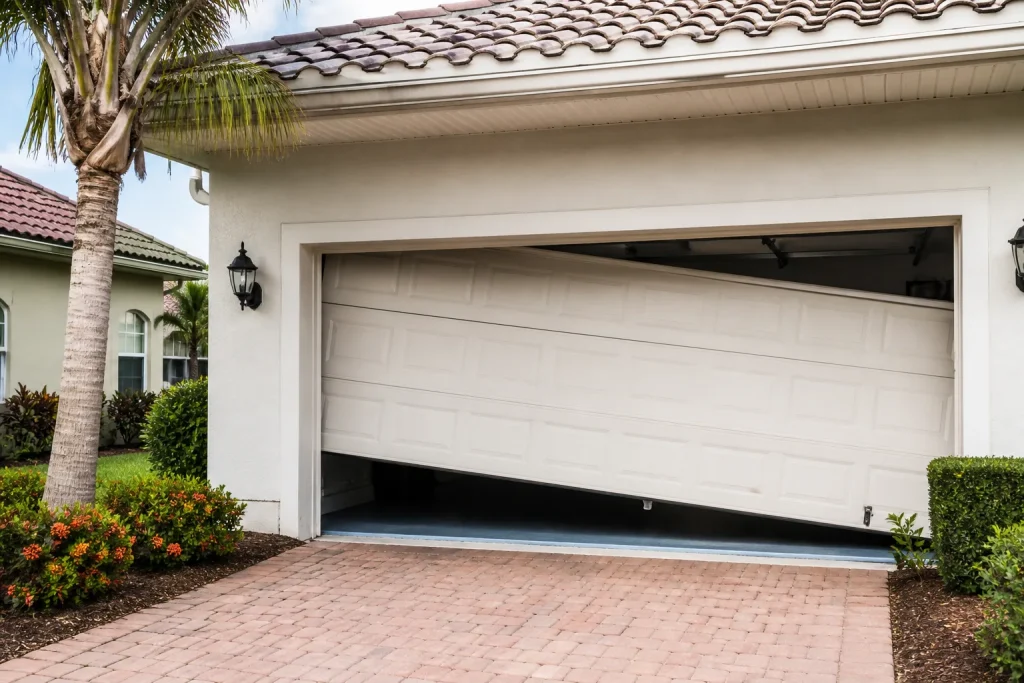
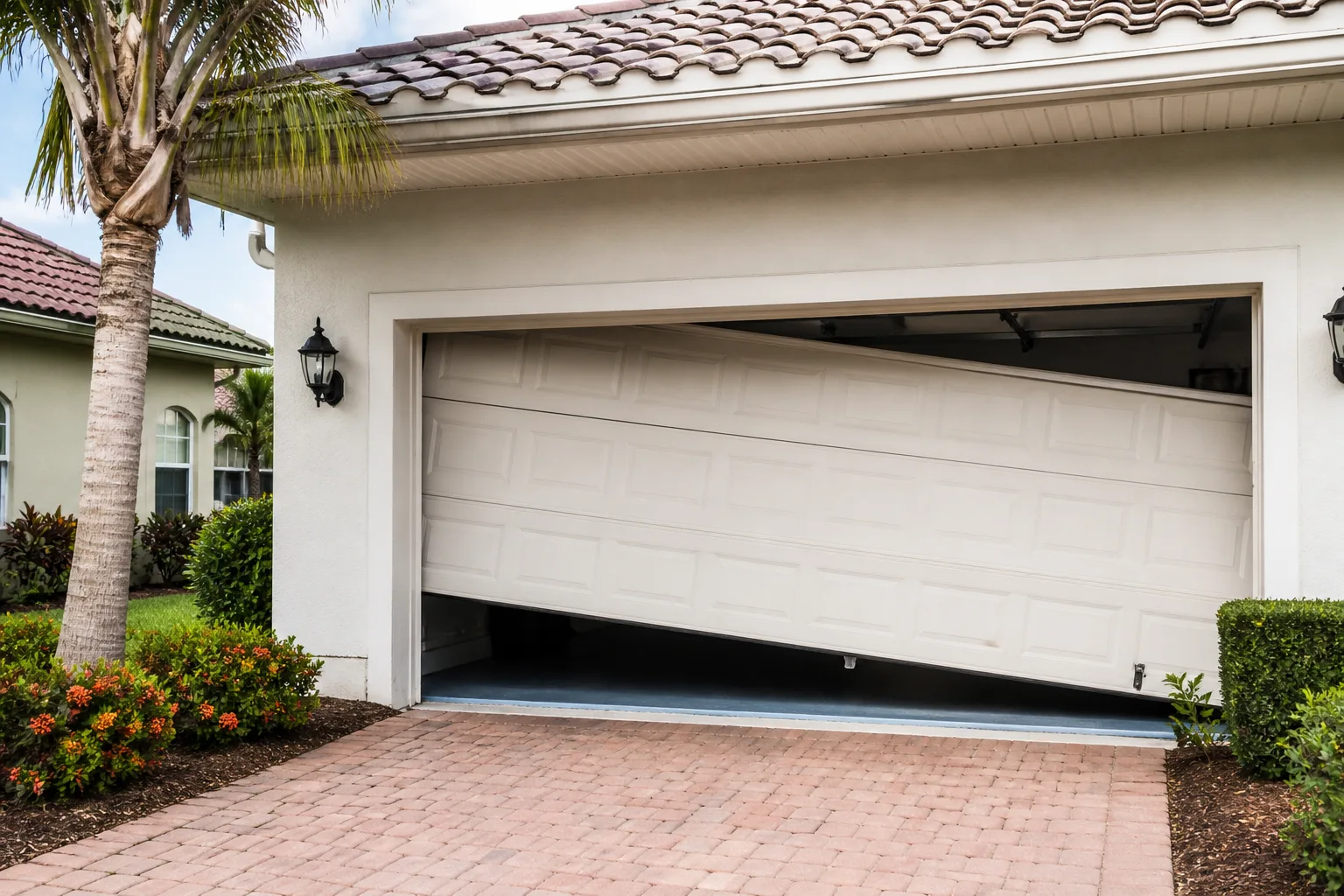
- The door travels unevenly or hangs on one side. A door coming up crooked is fighting its own cables or springs. That misalignment works loose the tracks and puts uneven load on the opener.
- The door reverses before it closes all the way. Sometimes it’s the safety sensors, sometimes it’s the door binding. Either way it isn’t safe to leave a door that won’t close reliably.
- Visible rust or dust on the rollers and track. Not cosmetic. Rust on the bearings and track rollers is the leading early sign of trouble in this climate.
- A door that shudders or vibrates as it moves. A balanced door glides. Shudder usually means a roller or hinge has worn and is dragging.
In our experience, most of these are a straightforward fix when caught in this window, and a much bigger job once they’ve run for a few more months. This is the tier where a little attention saves a lot of the repair bill.
Signs to Schedule Soon (Slow Response and Drift)
Nothing here is an emergency yet, but each one is a mechanical warning that the door is out of adjustment. These are the signs homeowners most often dismiss as “normal wear.” They’re not normal, they’re just slow.
- The door is noticeably slower than it used to be. A door that’s taken a couple extra seconds per cycle for weeks is a spring losing tension or an opener straining to lift an unbalanced door.
- You have to hold the wall button to close it. A worn or misadjusted limit switch on the opener can cause this. It’s fixable and worth fixing before the opener motor wears out.
- The door isn’t level when it comes to rest. One side touches down before the other. A few slightly off-balance doors are fine; a door creeping out of balance is a spring losing tension.
- The opener lights flicker or the remote is less responsive. Could be the opener, could be the mechanical load it’s pushing against. Worth having checked.
- Creaking or popping when you open the door from inside. Usually lubrication and adjustment, but it’s the sound of parts working against each other instead of with each other.
The Balance Test: How to Check Your Door Properly
The balance test is the single best check a homeowner can do. It tells you whether the springs are doing their job or whether the opener is lifting the entire door weight on its own. Here’s how to run it safely and what the result actually means.
- Close the door and disconnect the opener by pulling the release cord (usually red) hanging from the rail. This puts the door in manual mode.
- Lift the door by hand to about halfway up. Use one clean motion and steady pressure, not a yank.
- Let go. The door should stay put, or move only slightly, at the halfway point.
- Lower it to partly open. It should hold there too.
Pass: the door stays where you leave it, or creeps only an inch or two. Fail: the door drops on its own or shoots up. Either way, the springs are out of balance and the door is running on the opener when it shouldn’t. One more fail sign: if you can’t lift the door by hand at all, the springs may be weak, and if it feels unnaturally heavy, leave it alone and call a pro. Never test a door with a visibly broken spring or frayed cable.
The Opener-vs-Mechanical Misread (Why Homeowners Assume the Opener Is Failing)
Most of the calls we take for opener repair in Davie turn out to be a mechanical problem wearing out the opener. The opener is doing what it’s told. It’s the springs, rollers, or tracks that are making it work harder than it should. Here’s how to tell the difference from the driveway before you pay to replace an opener you don’t need to replace.
- The door struggles but the opener motor sounds normal. If the motor hums along at its usual pitch but the door moves sluggishly, the load is the problem, not the opener.
- The opener is fine when the door is disconnected. A quick manual-run test with the release cord tells you which side of the system is failing. If the door is hard to move by hand, the mechanical system is the culprit.
- The opener strains or stops partway up. That’s a door-weight issue. A healthy door balances so the opener only assists. When it has to drag the whole door, the motor heats up and the safety reversal trips.
- The door works inconsistently from the opener but the remotes are fine. Look at the door and springs first, then the opener logic.
Opener brands like Genie and LiftMaster are reliable systems, and they’re rarely the first thing to fail. When an opener does need attention – a worn gear, a failed logic board, a dead capacitor – we handle garage door opener repair across smart, legacy, and hybrid systems.
The Twice-a-Year Inspection That Catches Most Problems Early
Twice a year, walk out to the garage with a flashlight and give the door ten minutes. This visual pass catches most developing problems before they fail, and it costs nothing. In Davie, run it in spring and fall when the humidity shifts, since that’s when rust and cable wear tend to show up.
- Springs: look above the door for a gap in the torsion spring or a stretched extension spring. If either looks wrong, don’t test or use the door.
- Cables: check both sides for fraying, slack, or rust at the drum. A single loose strand is a call-a-pro sign.
- Rollers and hinges: look for rust, flattened wheels, or a roller popped out of the track. Rusted rollers are the most common early failure in this climate.
- The track: run your eye down both tracks for bends, dents, or debris. Any kink in a track is a problem.
- Balance and safety reversal: run the balance test and, with the door closing, pass a small object in the sensor beam to confirm it reverses. That’s your safety net.
A door that fails this inspection in two minutes isn’t a door that needs a full replacement. Most of the time it’s garage door repair on a single component, and catching it in this window keeps you out of the emergency tier.
When to Call a Pro (And Where We Fit In)
Springs and cables aren’t a homeowner project. The tension on a standard residential spring is enough to seriously hurt someone, and the correct fix requires the right winding bars and a trained hand. If you’re unsure what you’re looking at, the safe move is to stop and let a technician diagnose it. Our technicians have up to 14 years of experience with torsion and extension systems, and spring work is a dedicated service for us, not a sideline.
We work on the major door and opener brands – Clopay and Amarr doors, LiftMaster and Genie openers, Wayne Dalton and Chamberlain systems – so we show up already knowing the tolerances and parts of whatever is on your garage. If the problem is a worn mechanical component on a fully healthy door, we also handle garage door installation when the door itself is past saving and replacement makes more sense than another round of repairs. One call covers repair, install, or emergency, and the written estimate is the price.
If you’re in Davie and this article is telling you it’s time, Davie Garage Door Repair Pros is a call away.
The Bottom Line
Sort your warning signs by urgency, not by how scary they look. A snapped spring, a frayed cable, or a door that slams shut gets called today. Grinding, uneven travel, and a door binding in the tracks gets booked within the week. Slow response and balance drift get scheduled soon. In Davie’s humidity, that window is shorter than you’d think, and the twice-a-year walkthrough catches most of it before it becomes anything else.
If you’re in Davie and need help, Davie Garage Door Repair Pros offers free estimates – call (855) 658-4182. We answer 24/7. Fast dispatch from 7am to 7pm, Sunday through Friday. The price is set by the written estimate before any work starts.
Frequently Asked Questions
A broken spring is usually obvious: you’ll hear a bang, the door won’t lift, and you’ll see a gap in the spring above the door. Worn springs are quieter – the door gets noticeably slower and fails the balance test by dropping on its own. Never test a door with a visibly broken spring. Call (855) 658-4182 for an exact quote – estimates are free.
Yes, but less often than people assume. When a door struggles, it’s usually the springs or rollers making the opener work harder, not the opener itself. Run the manual test with the release cord: if the door is hard to lift by hand, the mechanical system is the problem. If it moves smoothly but the opener still fails to lift it, the opener is the culprit. Call us and we’ll diagnose which side of the system you’re dealing with.
Get it checked. A door that’s been slowing down for weeks is a spring losing tension or an opener straining against a door that’s out of balance. That’s the “schedule soon” tier – and it’s exactly the window where a small fix keeps you out of a bigger repair. Call (855) 658-4182 for a free estimate.
No. The written estimate sets the price per job, and that’s the price. We quote and agree on the cost before any work starts, so you won’t get an invoice that looks different from the number you approved. Call (855) 658-4182 for an exact quote – estimates are free.
Yes, for genuine emergency calls. We answer 24/7, and fast dispatch runs from 7am to 7pm, Sunday through Friday. A call outside dispatch hours is booked into the next opening. Call (855) 658-4182 and we’ll get you scheduled.
Written by the team at Davie Garage Door Repair Pros.
Need Garage Door Help?
Call Davie Garage Door Repair Pros - the local pro we connect you with is licensed and insured, here with fast help in Davie.
(855) 658-4182